
Noble County Court Record Requests
Climb the ladder in order. Indiana MyCase comes first for public summaries and some documents. The courthouse basement terminal then offers basic in-person search help. A non-online public copy or a certification goes through the Clerk of Noble County Courts. Call, email, visit, or mail that office. A hearing or trial transcript is different: reach the reporter through the assigned court.
- Search the case in MyCase and note the full court number, caption, and document or CCS event.
- Download a public image when available, or use the basement terminal at 101 North Orange Street in Albion.
- Call 260-636-2736, email clerk@nobleco.gov, visit the counter, or mail a request to the Noble County Courthouse.
- State whether a plain or certified copy is needed, plus the date range, format, and return contact.
- For a transcript, identify the hearing date, judge, court, and proceeding for routing to the court reporter.
Indiana's public-record request guidance points offline records to the clerk of the county where the case was heard. Clerk staff can walk you through procedure. They cannot make excluded content public, and they cannot tell you what legal step to take.
Noble County Clerk Record Desk
The official Noble County Clerk page names the record keeper and posts the public links, fees, and payment rules.
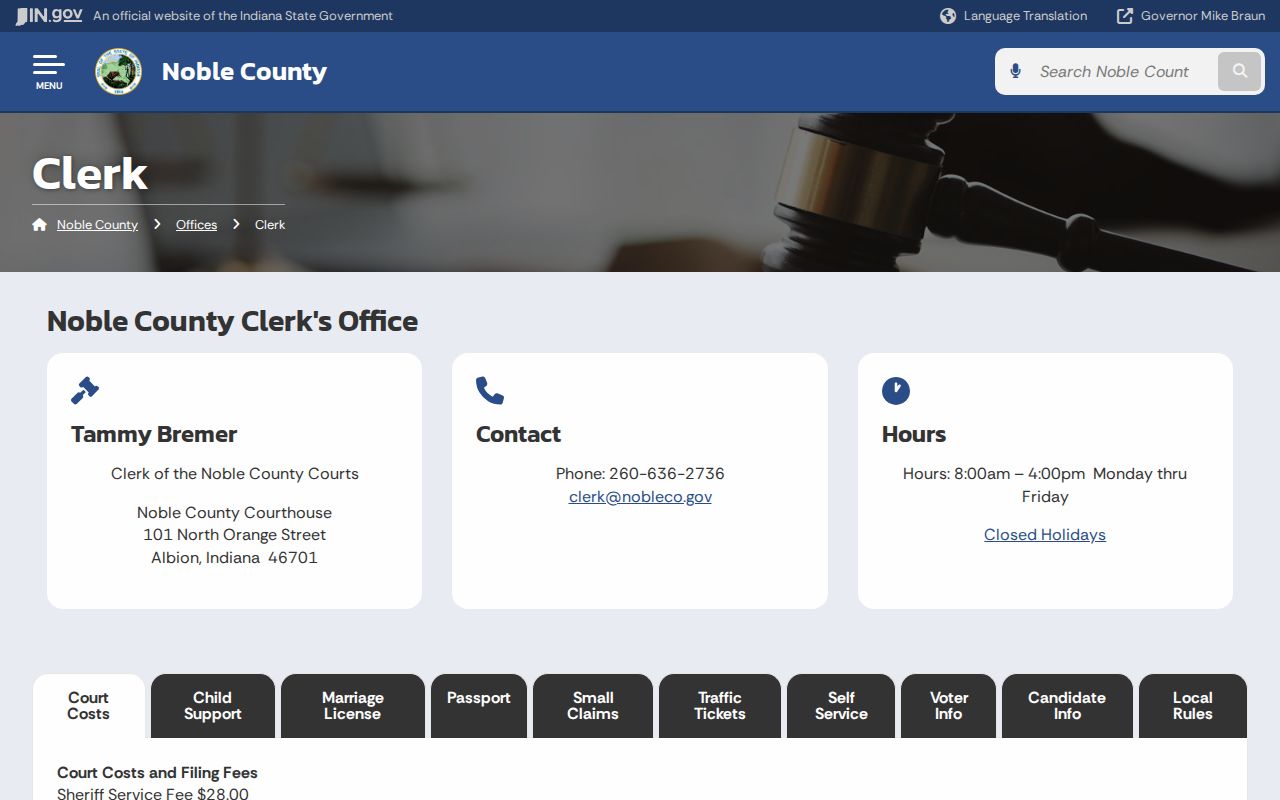
The clerk's page shows Tammy L. Bremer's unified office serving all three courts. It keeps records for Circuit Court, Superior Court I, and Superior Court II.
Clerk of Noble County Courts
101 North Orange Street
Albion, IN 46701
260-636-2736
clerk@nobleco.gov
Monday through Friday, 8:00 a.m. to 4:00 p.m., closed holidays.
Name the division if you know it: 57C01, 57D01, or 57D02. Include the full case number, case type, caption, the exact document or event, and how you want delivery. Before paying, ask staff to confirm mailing, pickup, identity, and current payment rules. Never assume an unlisted charge is zero.
Kinds of Court Records
The Chronological Case Summary is the running register of events, and it is not the whole case file. The full file can hold complaints or charging papers, appearances, service returns, motions, notices, exhibits where public, hearing entries, orders, judgments, and disposition documents. What you can reach depends on case type and on what each filing contains.
| Record | Custodian or route | Key detail |
|---|---|---|
| CCS/case summary | MyCase or clerk | Useful index, not a certified file. |
| Filed order or judgment | MyCase when public, otherwise clerk | Ask for plain or certified form. |
| Divorce decree | County clerk | State guidance says it is not supplied as a general online certificate. |
| Filed will or estate paper | Clerk where the estate was heard | Use the estate case number. |
| Transcript | Court reporter | Name the hearing date and proceeding. |
| Bulk compiled data | Indiana Office of Court Services | Written Administrative Rule 9(F) request. |
Marriage certificates also route through the county clerk. Adoption files are confidential and never an ordinary public request. Police reports, arrest records, BMV histories, and federal filings all live with different keepers.
Indiana Public Records Hub
The Indiana public records hub sends Noble County record seekers to case, protection-order, traffic, guardianship, and clerk resources.
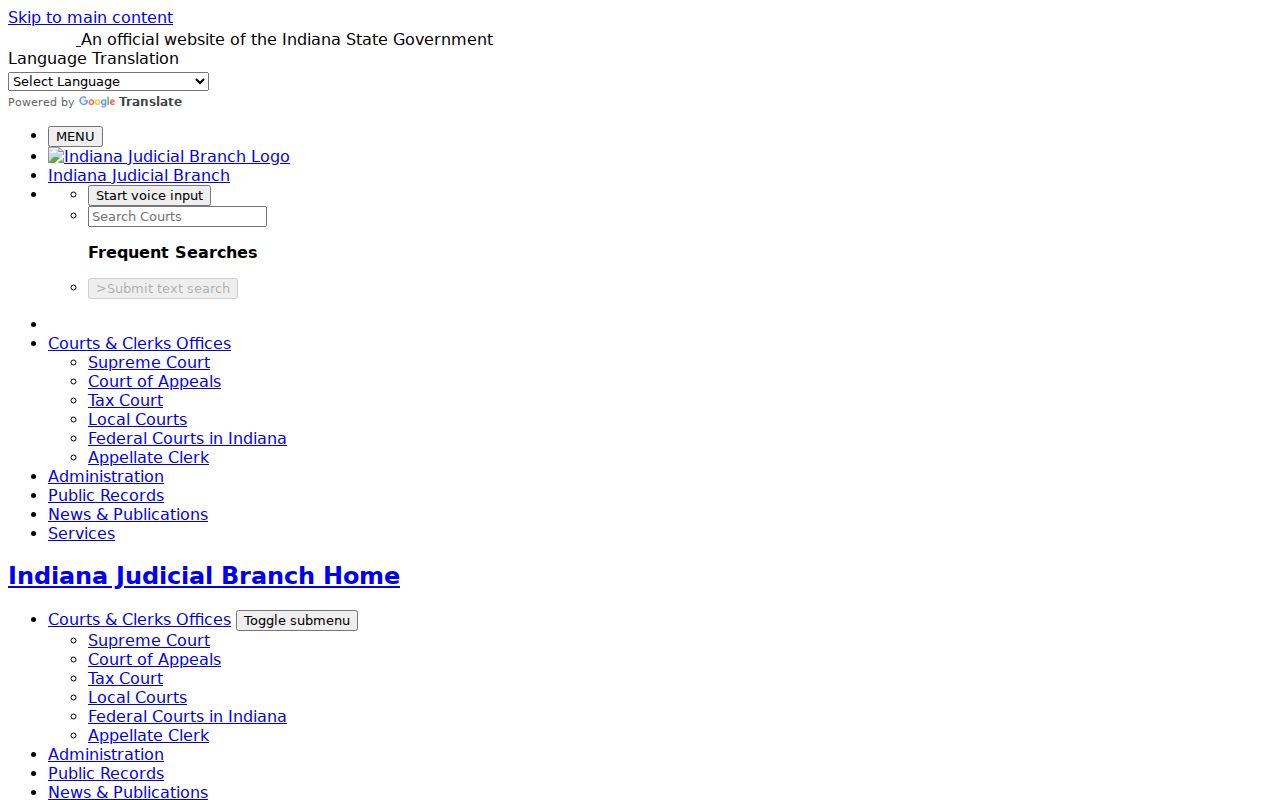
The hub is a routing page. One search box cannot cover every record family, so the official record always stays with the originating court or clerk.
For a routine request, try wording like this: “Please identify the Noble court and case number, the CCS event or document title and date, whether a plain or certified copy is available, the current fee, whether access is online or in person, and the mailing or pickup steps.” Skip the Social Security number and bank data. Also skip any personal detail the request does not need.
Court Records: What They Contain
Read a Noble County record block by block. The header fixes identity, and the party and attorney blocks show each person's role. The CCS lines up events in order. Charge, service, bond, financial, judgment, and document sections appear only when relevant and public, so a record can omit an older image, excluded material, or a field the court never entered.
| Case header | Court, number, type, filing date, status, and caption. |
|---|---|
| Parties | Names and roles shown in the public record. |
| Attorneys | Appearances and bar information where public. |
| CCS | Dated descriptions of filings, settings, orders, and dispositions. |
| Case-specific blocks | Charges, service, bond, judgment, or financial indicators. |
| Documents | Selected public images, subject to the access matrix. |
A CCS line is not always the document itself. When exact terms matter, ask for the named order or filing. An online screen is not the official record, and it can carry an error or omission.
Noble County Access Matrix
The official MyCase public-document matrix compares online and in-person access by case type.
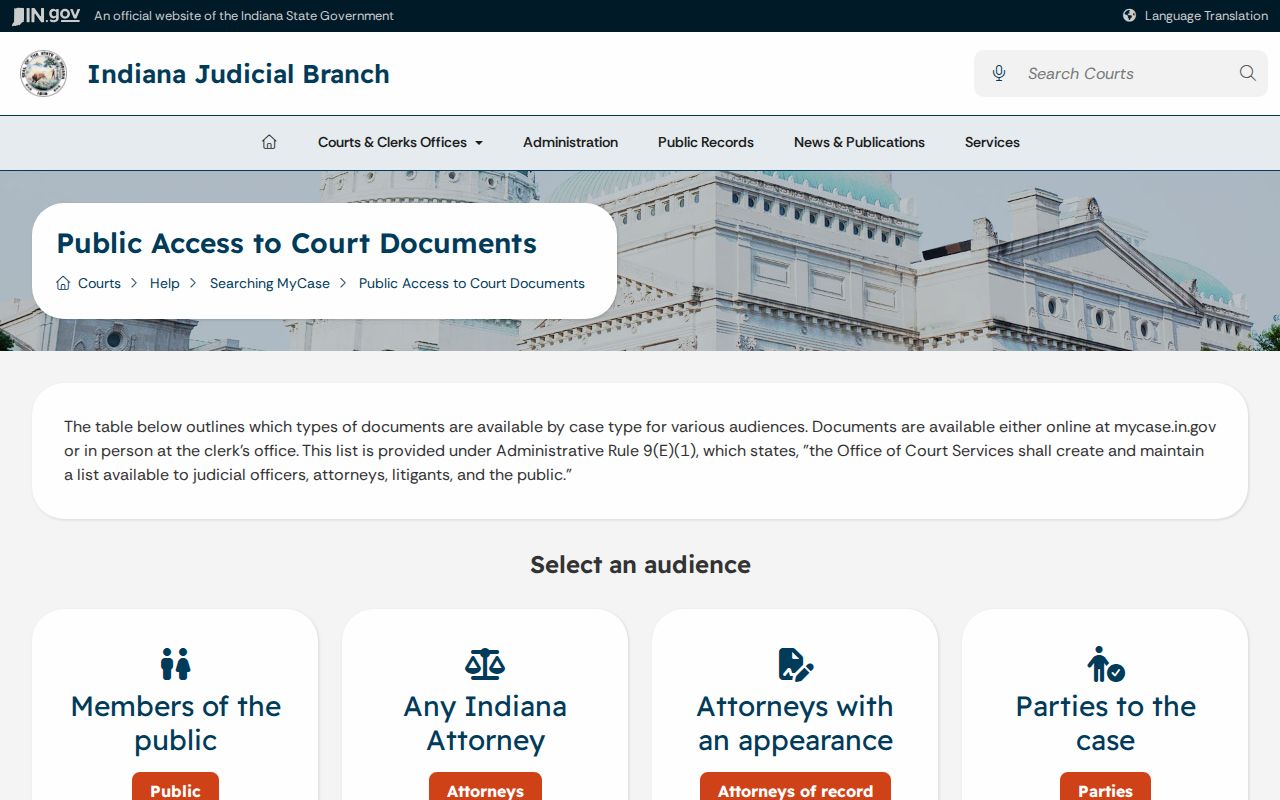
Here is the key lesson of the matrix. “Public” and “online” are not synonyms. Some orders appear remotely. Other nonconfidential papers require an in-person request.
Collections and tort matters can have nonconfidential orders and other documents online and in person. Criminal categories often expose sentencing or final orders, while access to other papers varies. Family records commonly have no online public documents, though some in-person access remains. Adoption and juvenile matters are sharply restricted. Protection orders use a separate public search.
Copy Fees and Certification
Certified copies from the Noble County Clerk cost $3 per copy. That figure comes from the fee schedule dated July 1, 2021. No personal checks are accepted. For services paid by name, bring cash, a money order, or a MasterCard or Visa credit/debit card. PayGov transactions add a vendor fee. These listed payments do not amount to a complete current copy schedule.
| Item | Published amount |
|---|---|
| Certified copy | $3 per copy, per the Clerk page |
| Ordinary photocopy | Confirm with clerk |
| Mailing or expedited service | Confirm with clerk |
| Transcript or audio | Confirm with court reporter |
| Exemplification or apostille steps | Confirm with clerk |
A certified copy carries the clerk's official certification, which is what most receiving offices require. A plain copy will not do. Ask first what certification the other office needs, then confirm the current total and an accepted way to pay.
Rule 4 Public Presumption
Access to Court Records Rule 4 sets the default. Court records are presumed open unless another rule or valid authority excludes them.
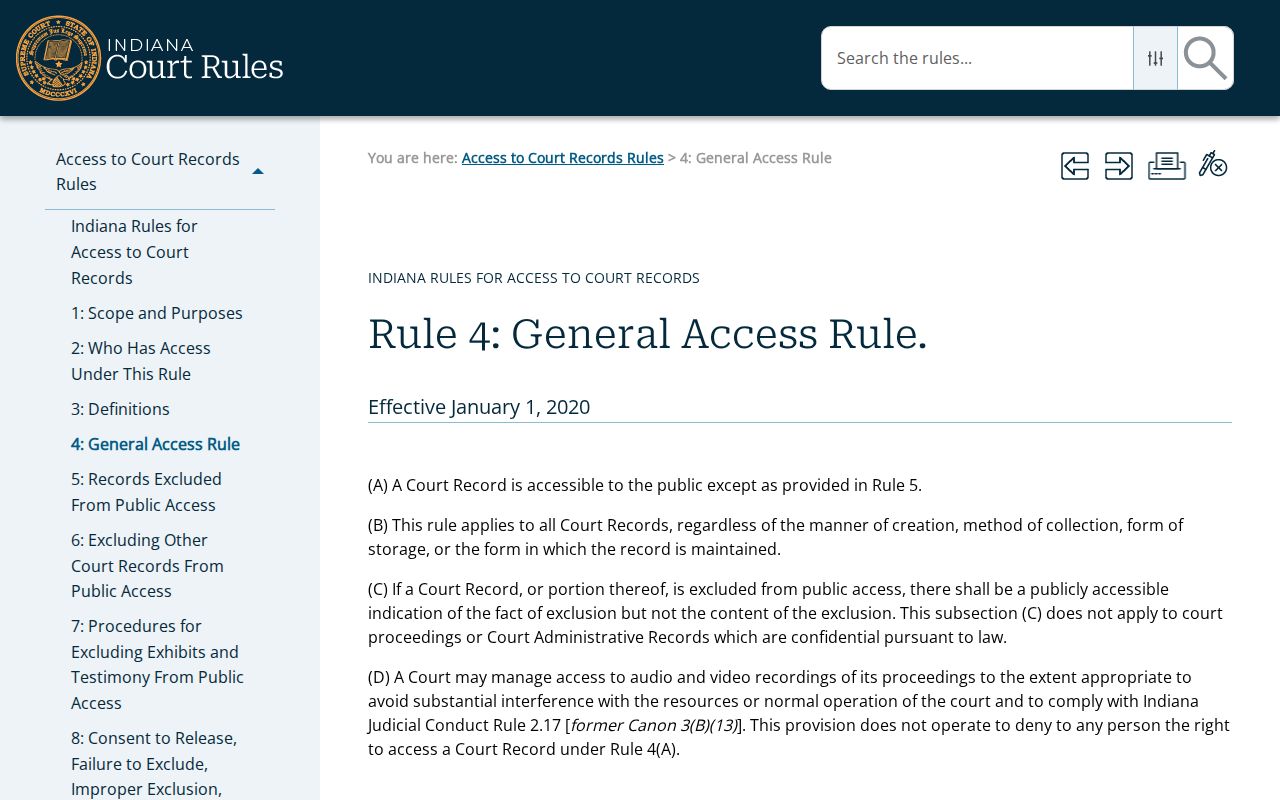
Rule 4 makes access independent of format, paper or electronic. If content is excluded, a public indication that a record exists may remain. The protected part stays undisclosed.
Rule 5 Protected Material
Access Rule 5 lists excluded cases, records, and protected personal information.
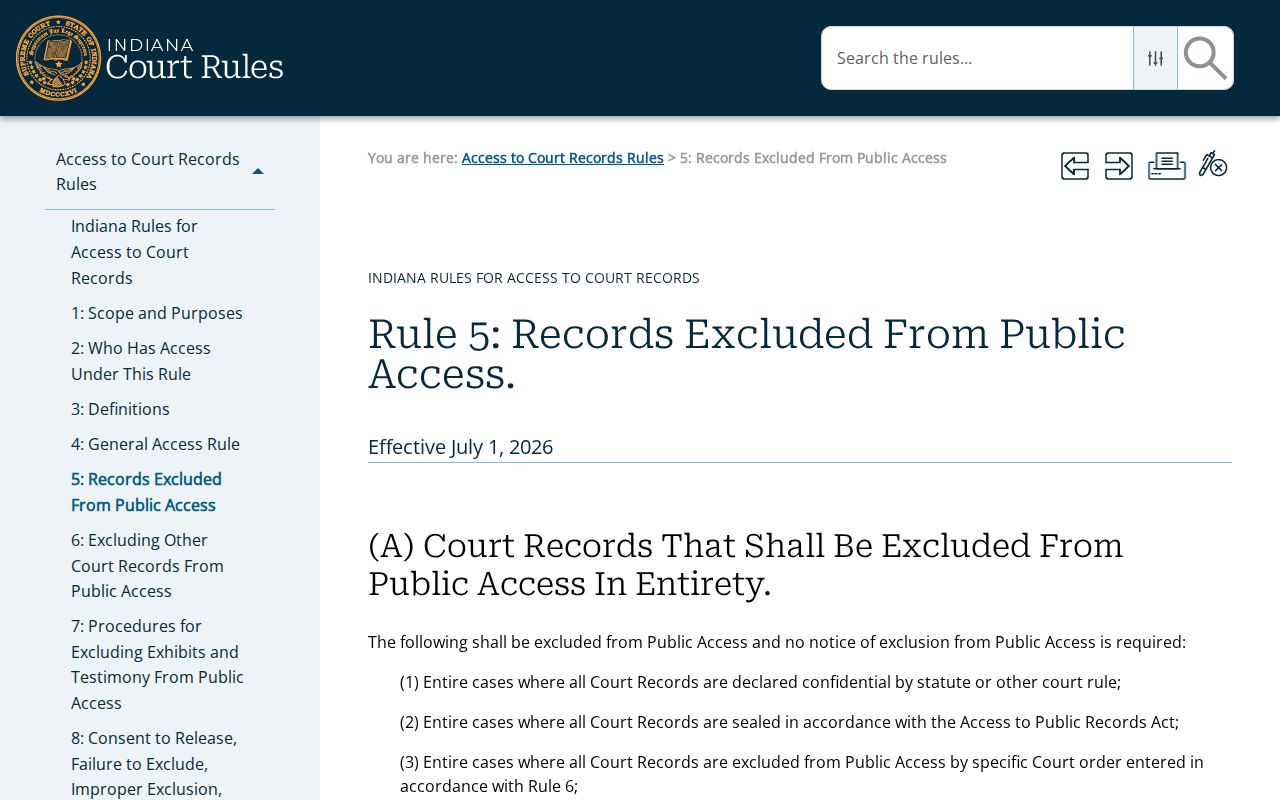
Redact account numbers, medical and treatment material, protected victim or witness details, and other listed data before anything is filed in Noble County court. A public case shell does not make every filing public.
Rule 6 Exclusion Process
Access Rule 6 offers an extraordinary process to exclude a record that would otherwise be public.
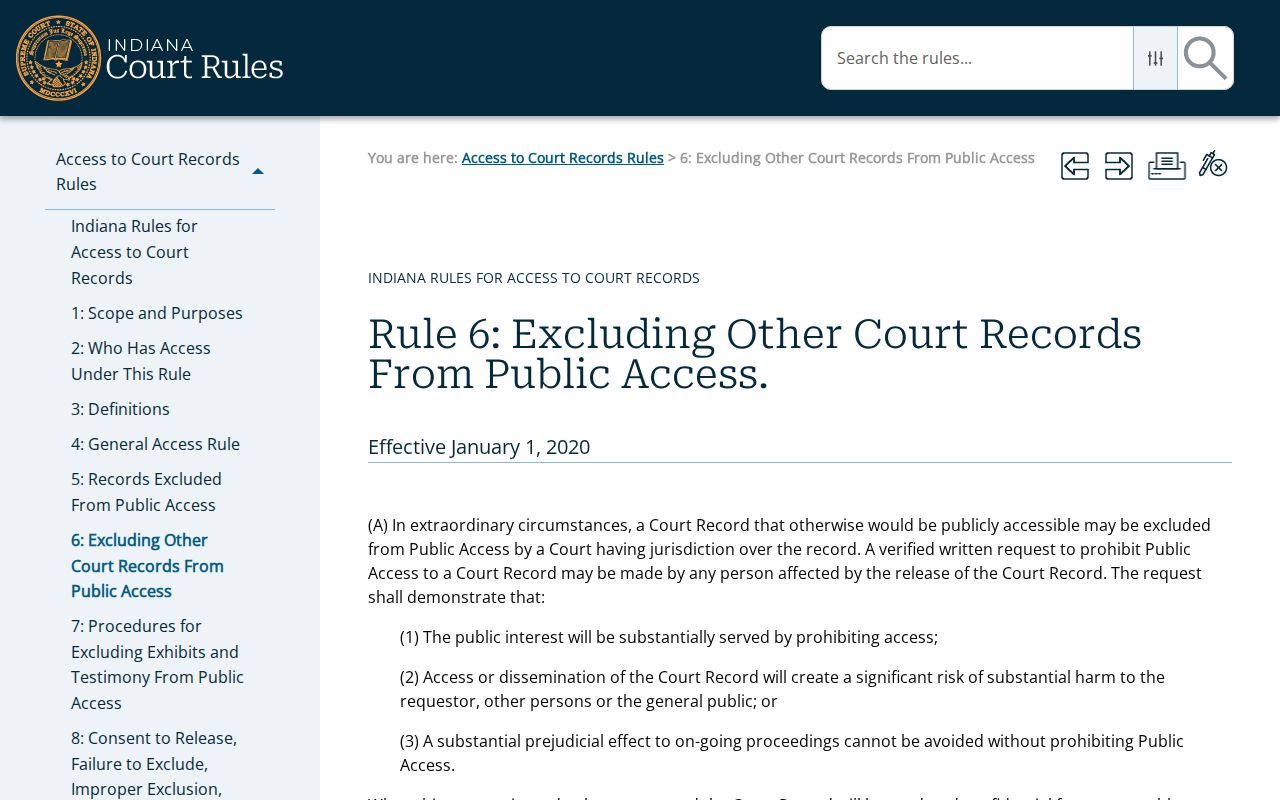
A Rule 6 exclusion is no casual call by a clerk. Noble County grants it only after a written, verified request, notice, a chance to respond, a hearing, and a written order, and any relief stays as narrow as the need requires.
Access Rules for Court Records
Access Rule 9 supplies the inverse extraordinary path for a person seeking excluded material.
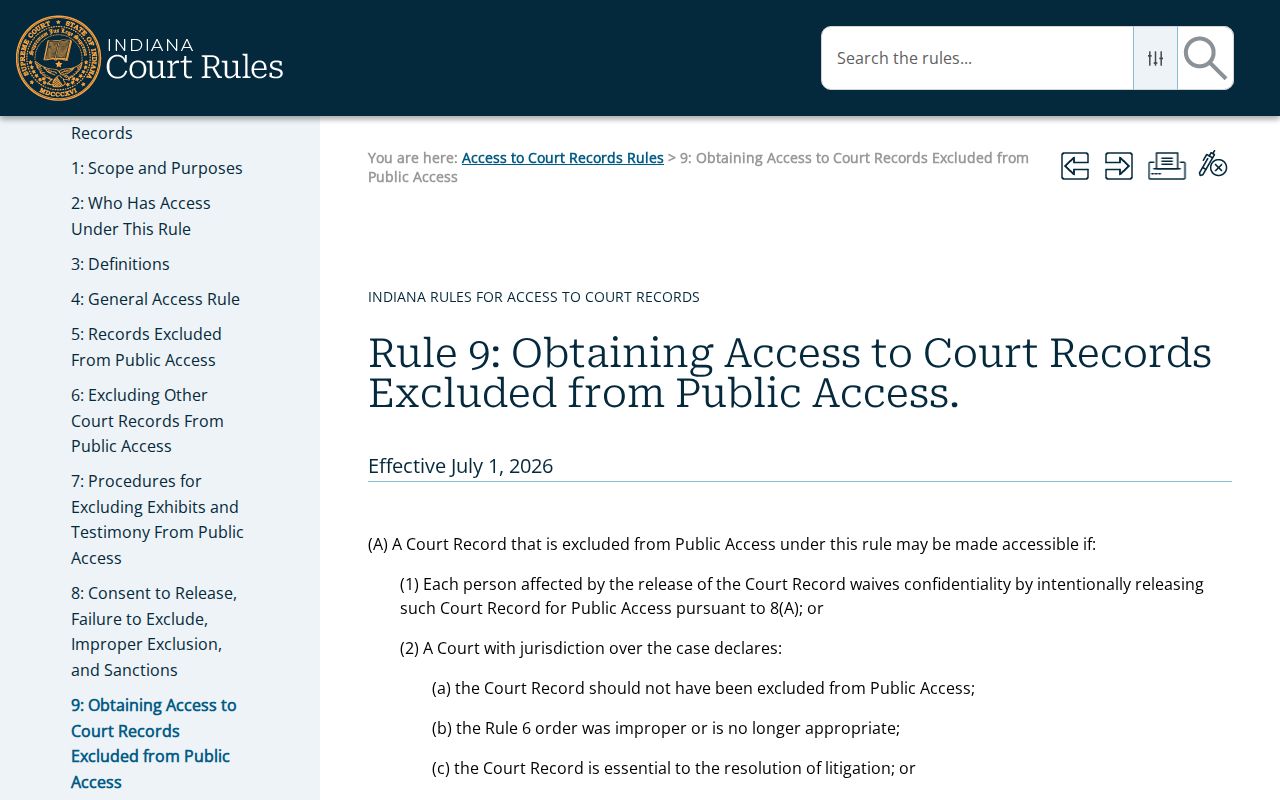
Sealed content works differently from an ordinary public-copy order. Expect a verified request, notice, a response period, a hearing, and a written decision before the court releases anything.
Indiana access framework: APRA, Access Rules 4, 5, 6, and 9, plus Administrative Rule 9, govern distinct parts of Noble County record access.
Begin with the clerk and the current rules. Ask whether a public or redacted version exists. Staff can route your forms and explain procedure, but they cannot argue the request, and a missing MyCase link never proves a record was destroyed or never existed.
Noble County Request Details
A good Noble County request splits the case search from the document order. The search first pins down the Noble court, the full case number, the caption, and the CCS entry. The order then names the exact complaint, motion, order, judgment, notice, or other filing. Vague asks like "the whole record" pull in items that are restricted, unavailable, or simply not needed.
Add a date range. A precise description of the event helps too. Together they let the clerk find the public item and set the correct charge.
State the format you want. Do not assume the office offers every delivery method. Ask whether the copy can be emailed, mailed, or picked up. Ask as well whether viewing at a public terminal would serve the purpose. If you need certification, say so before paying. Certification verifies the clerk's copy. It does not change the content of the underlying order. Another agency receiving the document may accept only certain forms, so ask that agency directly.
Transcripts demand different details. Provide the case number and the assigned Noble court. Name the judge, the hearing or trial date, and the type of proceeding. The court reporter can explain availability, preparation time, and the current cost. Remember that a CCS entry showing a hearing occurred is not a word-for-word transcript. An audio record is not automatically a transcript. Even where one exists and is available, it differs from a certified written transcript.
Older Noble County records may need extra routing. Historic events can appear as converted entries with no online image. Copy the exact wording and date from MyCase, then ask whether the clerk holds a paper or scanned public document. When a matter predates today's electronic display, absence from a download list settles nothing about what the official file contains.